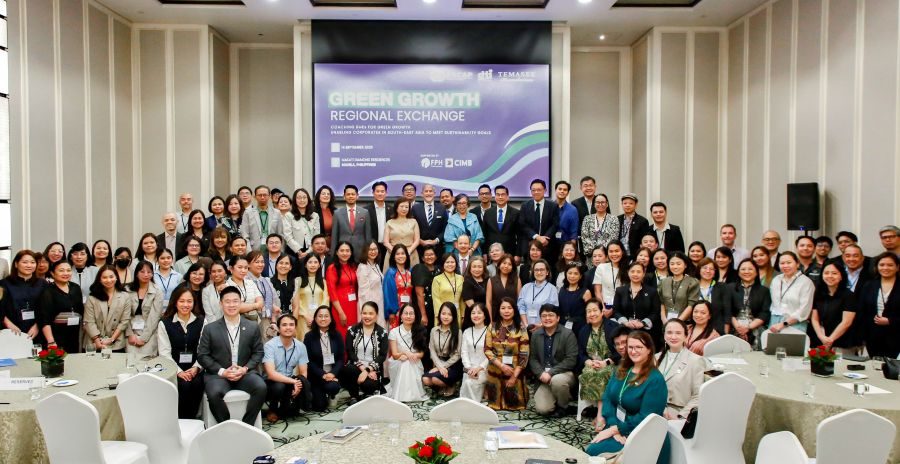







The Green Growth Regional Exchange concluded today in Manila, bringing together representatives of small and medium-sized enterprise (SME) development agencies, training and coaching organisations, corporates, SMEs, government agencies, financial institutions and development partners from across South-East Asia.
Presented by the United Nations Economic and Social Commission for Asia and the Pacific (ESCAP) and Temasek Foundation, and co-organised with the Department of Trade and Industry (DTI) of the Philippines, the one-day forum focused on accelerating the green transition of SMEs and their integration into sustainable supply chains. The forum was held with support from First Philippine Holdings Corporation and CIMB Malaysia.
Held under the theme “Coaching SMEs for Green Growth: Enabling Corporates and South-East Asia to Meet Sustainability Goals”, the exchange addressed a growing gap in the region’s supply chains. Large companies have made sustainability commitments that depend on their suppliers, yet many SMEs lack the information, skills, financing and market access needed to adopt greener practices.
The event sets out to strengthen the capacity of SME agencies and training organizations to support SMEs in their green transition, to boost the sustainability performance of SMEs, and to facilitate linkages between green SMEs and large enterprises.
The exchange was the first regional gathering convened under the Green Shift programme, a joint initiative of ESCAP and Temasek Foundation that aims to accelerate the green transition of SMEs in Malaysia, the Philippines and across South-East Asia. In the Philippines, the programme is implemented with DTI through its Bureau of Small and Medium Enterprise Development (BSMED) and the Philippine Trade Training Center (PTTC).
“There will be no green transition without SMEs. By equipping small businesses with the skills, partnerships and tools they need to become more sustainable, we can accelerate climate action while creating new opportunities for growth, jobs and competitiveness across the region,” said Mr. Shombi Sharp, Deputy Executive Secretary of ESCAP.
Mr. James Chan, Head of Programmes Office & Resilient Societies at Temasek Foundation, said “SMEs are the heart of our economies. We believe sustainability should not simply be another requirement to meet. It should also make business sense. Through this partnership with ESCAP, DTI and SME Corp, the Green Shift programme hopes to help SMEs translate sustainability ambitions into practical green action plans, strengthen their competitiveness and unlock new market opportunities across the region.”
Assistant Secretary Grace F. Baluyan of the Regional Operations Group, Department of Trade and Industry (DTI) of the Philippines, said, “Corporate sustainability commitments cannot be achieved in isolation from the thousands of smaller enterprises that supply, manufacture, transport, package, service, and distribute the products on which our economies depend. We cannot simply ask SMEs to transition toward greener business practices and expect the transformation to happen on its own.
Governments, financial institutions, large corporations, development partners, and SME support organizations all have a shared responsibility to create the enabling environment that allows SMEs to succeed in this transition.”
A high-level panel on promoting green supply chains brought together senior representatives of government, corporates and financial institutions from Malaysia, the Philippines, Singapore and Thailand to share experiences in advancing green business models and strengthening sustainable supply chains, highlighting key policies, innovations and partnerships. Participants then joined an interactive workshop on the SME coaching process, which introduced the SME Coaching Toolkit for Green Growth developed under the programme and invited SME agencies and training organisations to reflect on how the toolkit could be applied in their own work.
Deep-dive sessions explored how corporations can collaborate with SMEs in their supply chains to meet sustainability targets, and how SMEs can engage potential clients in green supply chains and pitch a compelling green growth story. Sector breakout panels on manufacturing, agriculture and food, construction, and services – covering transport and logistics and tourism – introduced corporates and stakeholders supporting the green transition of SMEs in each sector, while dedicated networking spaces enabled SMEs, corporates and business support organisations to connect directly.
The exchange closed with a discussion on scaling up coaching for the green transition of SMEs and the development of green supply chains across the region, drawing on the experience of SME development agencies and training institutions from the Philippines and Viet Nam.
Building on the exchange, the Green Shift programme will continue to support SME development agencies in Malaysia and the Philippines to coach SMEs on green action plans and connect them with corporate buyers, and will share lessons from the 2026 pilot with additional countries and partners across South-East Asia.