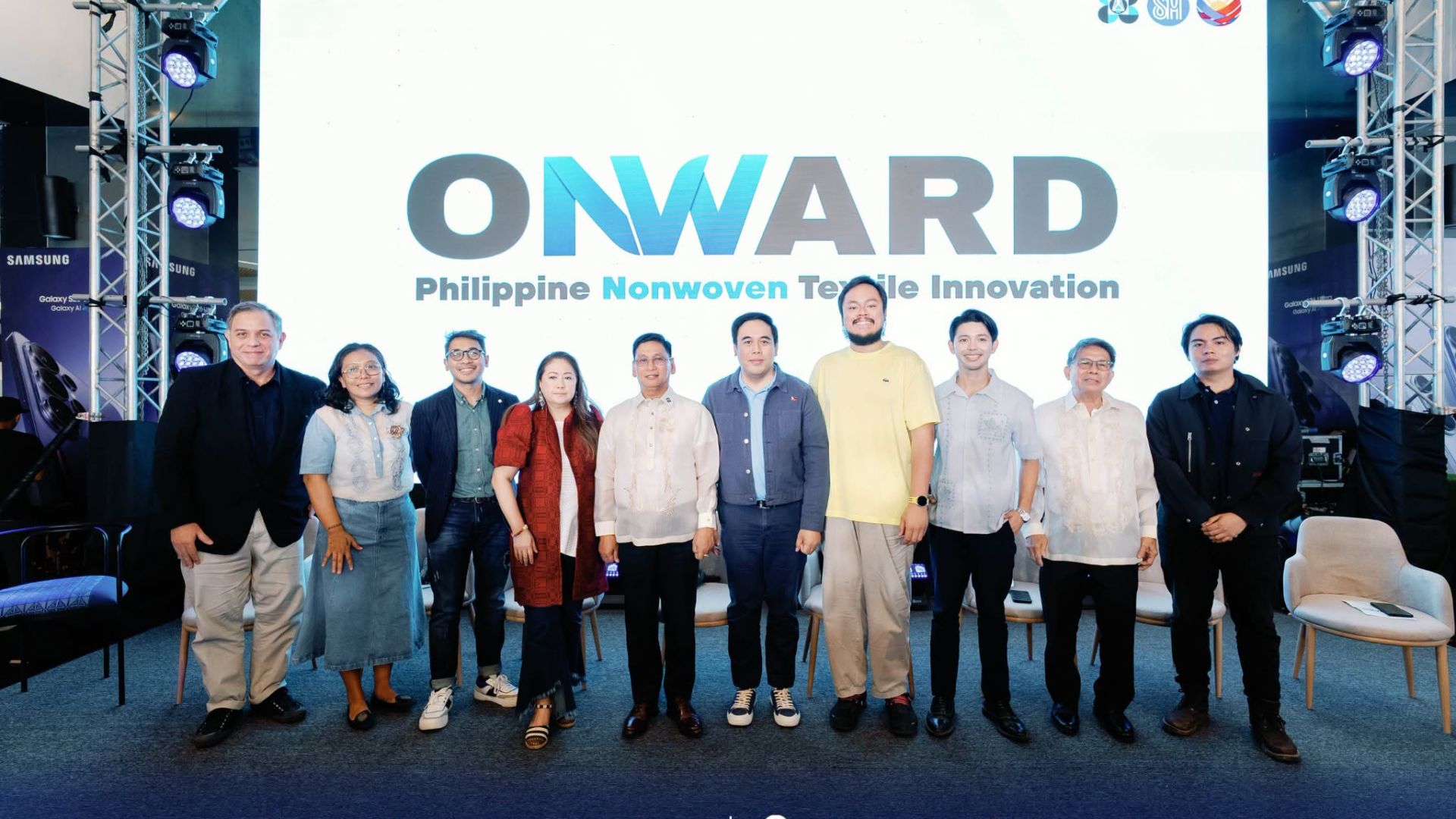







Have you heard of nonwovens?
Chances are, you’ve already used them today, and they could help shape the future of sustainable manufacturing in the Philippines.
From the moment you wake up, nonwovens are already part of your daily routine. They can be found in mattress components, the face mask you wore, the lining inside your shoes, the upholstery in your car, even some medical products and household wipes, all of which rely on nonwoven textiles. While often overlooked, nonwovens are among the world’s most versatile materials.

Imagine if these everyday products were made not from petroleum-based plastics but from agricultural waste such as banana pseudostems, pineapple leaves, bamboo, water hyacinth, and other local materials. This presents a sustainable alternative to plastic-based production, which lessens greenhouse gas emissions that cause climate change.
The Center for International Environmental Law (CIEL) reported that emissions occur throughout the entire plastic lifecycle, from production to disposal. To address this, CIEL advocates for extended producer responsibility (EPR) to support a circular economy and reduce emissions across sectors, including plastic production.
Introducing DOST-PTRI’s Natural Textile Fiber-Based Nonwovens
This aligns with the vision being advanced by the Department of Science and Technology – Philippine Textile Research Institute (DOST-PTRI). Using nonwoven technologies composed of more than 75% natural textile fibers for needle-punched nonwovens, the Institute is transforming local agricultural byproducts into sustainable materials that reduce dependence on synthetic plastics while creating new opportunities for Philippine local industries.
As climate change intensifies and industries move toward circular manufacturing, DOST-PTRI’s nonwoven innovations show that the next generation of sustainable materials may already be growing in Philippine farms.
Figure 1. Agricultural by-products, including pineapple leaves, water hyacinth, and banana pseudostems, used for natural fiber production.
Nonwovens and their diverse applications
Figure 2. Bamboo and Banana textile fiber based needle punched nonwovens.
Unlike traditional textiles, which require yarns to be woven or knitted into fabric, nonwovens are produced by bonding or interlocking fibers directly through mechanical, thermal, or chemical processes. These materials are commonly categorized into four major types: Airlaid, Drylaid, Wetlaid, and Spunlaid, each distinguished by its method of production. While nonwoven web formation is not limited to these techniques, they remain among the most widely used methods due to their versatility and ability to meet large-scale market demands. As a result, nonwovens have become integral to a wide variety of products used in everyday life across numerous industries.
Figure 3. Banana textile fiber-based wetlaid nonwoven, Indigo dyed banana textile fiber-based needle-punched nonwoven, and banana textile fiber-based needle-punched nonwoven with alternative leather coating.
Airlaid technology is specifically designed for processing short fibers dispersed in an airstream to form a fiber web. The resulting nonwoven materials are used in a broad range of applications, including wipes, absorbent hygiene products for babies, adults, and feminine care, food pads, disposable household and hospitality products, wound-care products, insulation materials, and filtration media.
Drylaid technology forms a web from fibers in a dry state, which may subsequently be bonded mechanically, thermally, or chemically. These are commonly used in automotive components such as headliners, filters, mattress manufacturing, and geotextiles. They also find applications in infrastructure projects, including waterproofing systems, insulation materials, and complex architectural designs, as well as wall and floor coverings, carpet backing, synthetic leather, and filtration products. In addition, drylaid nonwovens are widely utilized in hygiene and healthcare products such as diapers, face masks, medical gauze, and cosmetic cotton pads.
Wetlaid nonwoven fabrics are produced by dispersing fibers in water and forming them into a uniform web, similar to the papermaking process. The web is then bonded using thermal, chemical, or mechanical methods and dried to create a finished nonwoven material. Wetlaid nonwovens are widely used in wipes, filtration media, specialty papers, composite reinforcements, automotive components, construction materials, footwear components, and selected wearable and technical textile applications.
Spunlaid (spunbond) nonwovens are produced by extruding continuous polymer filaments that are laid into a web and bonded to form a strong and durable material. They are widely used in hygiene products, medical protective materials, geotextiles, packaging, agricultural covers, filtration products, and automotive applications.
With their diverse applications, nonwoven materials produced through drylaid and wetlaid processes, utilizing more than 75 percent natural textile fibers, promote sustainability and circularity across multiple sectors. These innovative materials can be used in a wide range of industries, including furniture and interior design, holistic roofing systems, fashion and accessories, smart infrastructure, modern landscaping, outdoor living solutions, transportation, agriculture, footwear, and healthcare. This demonstrates that nonwovens have a significantly broader market potential than traditional woven fabrics.
As the demand for sustainable materials continues to grow, nonwovens are emerging as one of the most versatile innovations in the textile industry. They play a critical role in the products, industries, and systems that shape everyday life while contributing to environmental protection and supporting local farmers through the use of sustainable, locally sourced raw materials. In many ways, we are already living in a world shaped by textile innovation, and nonwoven materials are at the heart of this transformation.
Nonwovens as a game changer in Philippine Industries
To further advance innovation, circularity, and sustainable manufacturing in the Philippines, DOST-PTRI caters to nonwoven development by providing machines and facilities for its innovation. The Institute continues to expand its partnerships with local industries, encouraging the integration of natural textile fiber (NTF)-based nonwoven materials as a substitute for other synthetic materials into both existing and emerging product lines.
This collaborative effort will take center stage through ONWARD: Philippine Nonwoven Textile Innovation, which is set to launch on 01 July 2026, at the SM North EDSA Annex Atrium. Open to the public, the event will showcase the transformative potential of nonwoven materials and highlight their role in the rapidly evolving landscape of both the local and global textile industries.
Figure 4. Onward launch poster.
“Onward, technically means moving forward because we have already established ourselves in woven materials. We now want to leverage sustainability and technical innovation, and nonwovens are the perfect fit. We branded all our nonwoven applications as onward since we want to take it on to the next stage. The focus is on creating greater value, achieving larger-scale production, and expanding applications beyond our traditional woven products and apparel,” Dr. Julius L. Leaño Jr., Director of DOST-PTRI explained the reason behind the Onward brand name for their nonwovens innovations.
Among DOST-PTRI’s product development partners is Sarao Motors, Inc., the premier builder of the iconic Philippine jeepney, which is exploring innovative nonwoven applications for jeepney interior components such as in their upholstery and headliners.
Also joining the initiative is Creative Definitions, a design and material innovation company known for championing sustainable textiles derived from natural fibers. The company has collaborated with DOST-PTRI in developing sustainable footwear.
Another key partner is Base Bahay Foundation, Inc., an organization focused on research and development for sustainable and disaster-resilient housing solutions that incorporate bamboo-based materials.
Meanwhile, Jed Yabut Furniture & Design continues to demonstrate how contemporary Filipino furniture can be elevated through the use of locally sourced and sustainable materials and is now working with NTF-based nonwoven material.
Also part of the growing network is Junknot, a Filipino design brand specializing in sustainable furniture and interior pieces crafted from upcycled industrial and post-consumer waste.
Fivecent Global Corporation, a Philippine-based company engaged in industrial and technical textile initiatives, has likewise collaborated with DOST-PTRI through the Philippine Medical Textile Testing Center and in the exploration of meltblown nonwoven technologies that support advancements in local personal protective equipment (PPE) and textile manufacturing.
Part of the roster is the Fashion Accessory Makers of the Philippines (FAMPh), an organization that champions Filipino craftsmanship, indigenous materials, and sustainable design while promoting local artisans and expanding the reach of Philippine fashion accessories in both domestic and international markets.
Renz Reyes, a local clothing brand known for intricate textile design and bridging the gap between artistic craftsmanship and ready-to-wear (RTW) practicality, is also part of Nonwovens’ efforts to transform innovative textiles into remarkable fashion.
With such a diverse range of applications and industry partners, the ONWARD launch invites manufacturers, designers, innovators, and the general public to witness the future of Philippine textile innovation. Visitors can look forward to insightful discussions from textile science experts and industry leaders, alongside exhibits showcasing how nonwoven materials are being applied across multiple sectors.
Figure 5. Leather nonwoven material and bamboo nonwoven material in footwear application.
More than a launch and exhibition, ONWARD highlights the powerful convergence of Filipino craftsmanship, sustainability, and technological innovation. The showcase will demonstrate how nonwoven materials can unlock new possibilities for product development while addressing the growing demand for environmentally responsible manufacturing.
“This is Onward, our new development in textiles and a new chapter in Filipino fabrics. We hope that you will give it a chance and the space it deserves,” Dr. Leaño added as he called on the public to support this emerging innovation in textile science.
With its expanding network of partners and groundbreaking applications, this initiative represents more than just another technological milestone. It signals a transformative shift for the Philippine textile industry, one that positions the country at the forefront of sustainable material innovation while creating new and sustainable opportunities for local industries to thrive in a rapidly changing global market.